
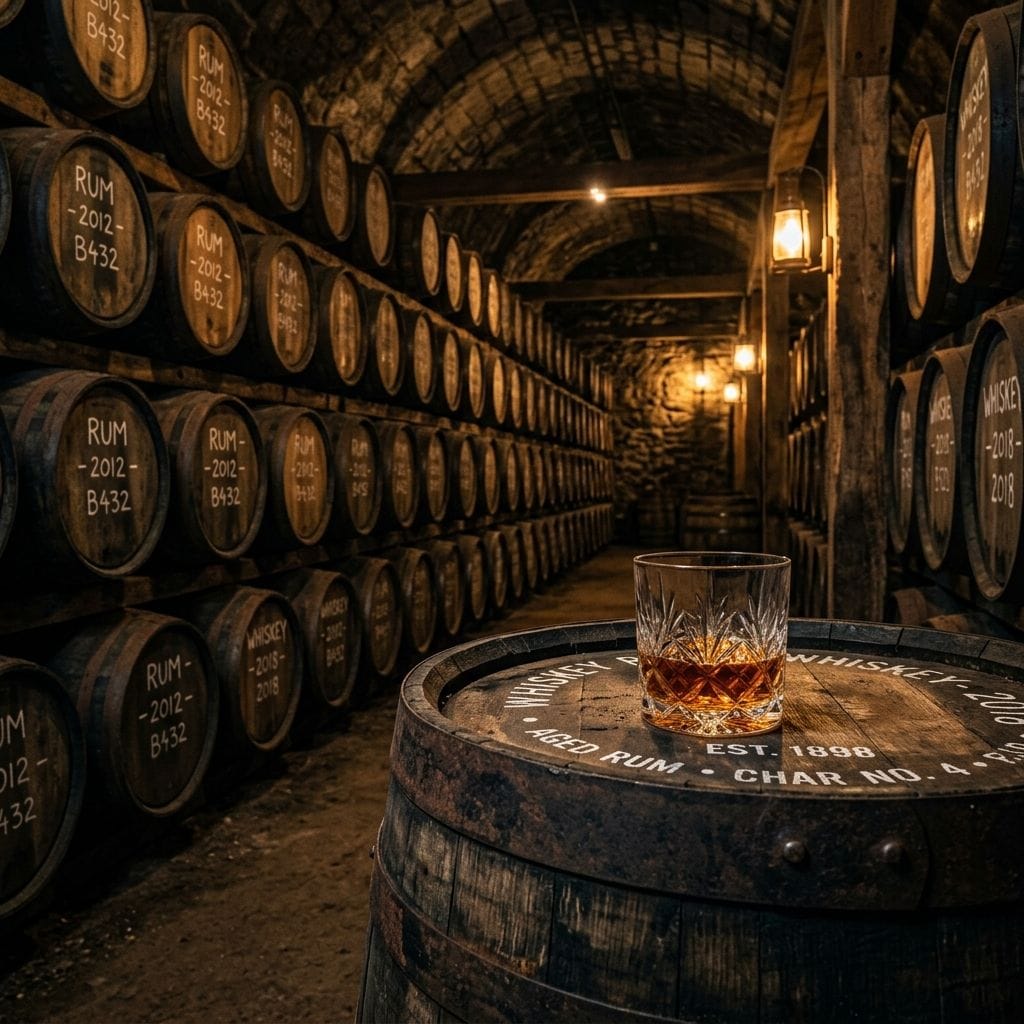
When a spirit first comes off the still, whether it's destined to be Bourbon, Scotch, or dark Rum, it is completely clear and often harsh on the palate. The magic happens in the darkness of the barrel.
Barrel aging is a complex chemical dance between the liquid, the wood, and the environment. Up to 70% of a dark spirit's final flavor and 100% of its color comes entirely from the oak barrel it rests in.
Extraction, Subtraction, and Oxygenation
The process works in three main ways. First, extraction: as temperatures fluctuate, the spirit expands into and contracts out of the wood, extracting flavorful compounds. Lignins break down into vanillin (giving notes of vanilla), while hemicellulose provides caramel and toffee notes.
Second, subtraction: the char layer on the inside of the barrel acts as an active carbon filter. It pulls harsh, undesirable sulfur compounds and fusel oils out of the raw spirit, smoothing it out over time.
Finally, oxygenation: oak is porous. A tiny amount of oxygen slowly seeps into the barrel, triggering oxidation reactions that create complex esters—the compounds responsible for the fruity and floral notes in mature spirits.
The Angel's Share
Because the barrel is porous, a percentage of the alcohol and water evaporates into the air each year. This lost volume is romantically referred to as the 'Angel's Share.' It concentrates the remaining liquid, resulting in the rich, deep flavors that make aged spirits so highly prized.